- Continue Shopping
- Your Cart is Empty

Primary vs. Secondary
Quick tips: Primary moustache wax has a medium hold and is great for daily use. Secondary is a firmer wax perfect for more aggressive hold and styles.
One of the most common questions we hear is "Should I use Primary or Secondary Moustache Wax?" We appreciate customers wanting to make an informed choice - we're happy with the quality of our products and we want you to be confident in, and happy with, your purchase. Feel free to peruse this brief explanation of the differences between our moustache waxes, and contact us with any questions.
A thoughtful recipe
We have nothing to hide with our moustache wax. Our ingredients always have been, and always will be, printed on the label for you to see. Both of our waxes contain local (Michigan) beeswax, lanolin, castor oil, coconut oil, shea butter, and Vitamin E. After much experimentation, this is the combination of ingredients that we came up with to best style your moustache while being conscious of your facial hair's health as well. The same care that went into crafting the final recipe also went into the design and materials of our labels. Like with our traditional beard oils and Beard Dry Oil, the labels on our tins of moustache wax are oil proof and water proof.
Primary
In our description of our Primary Moustache Wax, we ask the question "Are you a laid back gentleman that would prefer to encourage your hairs rather than resort to force?" If so, this is your wax. Primary wax is a medium hold wax that is great for daily use. As we discussed in How to grow a handlebar moustache, training your moustache is an important part of the handlebar process. Primary is an excellent product to train your moustache, not only to shape a handlebar but also to encourage your moustache to lay the way you'd like, whether that be for the simple purpose of keeping it out of your mouth during the day or to help you cultivate your own moustache style. However, as Primary is a medium hold wax, it does allow users to craft more aggressive stylings that will hold up throughout the day.
Secondary
Our Secondary Moustache Wax is simply, "a firmer wax". If you are looking for a moustache wax that will allow you to craft the most detailed of stylings and keep it in place throughout the day and night, this is the wax for you. While Secondary was not designed with competitive facial hair events in mind, it has shone through as an ideal wax for competitive purposes; one that allows you to style your moustache and keep it in place throughout the rigors of competition as the night goes on. You'll notice that Secondary is firmer in the tin than Primary and thus requires more heat to make the wax malleable, but the application process is still straightforward and easy to do with some practice and the aid of simple tools like our wax lifters, Kent Moustache Comb, and a flat iron and/or a hair dryer on a low heat setting.
Don't be afraid to use wax on a daily basis
Regardless of whether you choose to use Primary or Secondary, don't be afraid to use moustache wax on a daily basis, especially if you are training your moustache. Knowing how to effectively use moustache wax is an important step in making sure that your moustache always looks its best. We designed our wax with daily use in mind, not just in the wax itself, but even in the tins themselves. Our tins have a slim profile that fits easily in even the smallest of pockets, making it a perfect addition to your every day carry. While you may not need to reapply moustache wax throughout the day, it is always handy to have on your person in case you need a touch up. Still haven't been able to decide which you would like? No problem; take advantage of our discounted Get A Pair package. Keep in mind, while we have been discussing the differences, Primary and Secondary work well in concert with each other. There are a number of customers who use Primary to wax the middle hairs of their moustache and then use secondary for the curls in a handlebar and other styles that may require more hold. Good luck, and happy waxing!
Should I get Beard Dry Oil or Traditional Beard oils?
Taking care of a beard is like taking the tire off a bicycle.
When I was about eight years old I decided my bike wheel needed to come off so I flipped my bike upside down and attacked the nuts that held the wheel to the frame with a Crescent wrench and a hammer because the threads were too tight for my little sausage fingers. My dad noticed what I was about to do but couldn't stop me in time. I managed to practically weld the nut to the shaft by cross threading it something fierce. What I learned was any time it occurred to me to grab a hammer to finish a job, I should probably also ask for some advice. (By the way, I was without a bike for a whole summer as a result of my "creative" approach to bike repair!).
Use the right tool for the job.
Suffice to say, I am now a big fan of using the right tool for the job. It helps if you have a good toolkit. For beards, this means having a traditional beard oil and a beard balm of some sort. My beard balm is called "Beard Dry Oil." It is also a good idea to have a high quality beard comb, a brush for shaping your beard and a Beard Oil Brush for application. With these tools, you are ready for anything. That said, you may not need everything at once. Since I have a year old beard and use both a traditional oil as well as Dry Oil. If you are buying a gift or want to know what to start with, here are some tips for picking the right product.
For shorter beards (or for more control)
In general, a Beard Dry Oil is best for beards younger than a couple months or for when you want a little more control. A beard balm style oil adds a little volume and really helps control "fly aways." In particular I use Beard Dry Oil for my sideburns or whenever I have slept on my beard and I have a bad case of "bed beard," or whenever I just want to have a sculpted look like Santa had in A Miracle of 34th Street. The way Beard Dry Oil works is that it contains a little beeswax and lanolin and provides a little structure. While it is mainly designed for shorter beards and touch-ups, it can be used as a daily oil, even on longer beards. Case in point, Brian Furby the beard expert from the beard and moustache product review site TitleBeard has a year old beard (aka "Yeard") and uses Dry Oil daily. He likes it because it provides the control he desires.
For longer beards (or for for shine without hold)
As my beard has gotten longer, I have come to really appreciate traditional liquid beard oils. These oils provide great hair health properties, add a really nice shine to my beard and smell awesome. Most folks I talk to with more than a few months growth prefer liquid oils because the Beard Dry Oil can weigh down longer beards if that is all that is used. Some guys like to use Beard Dry Oil and traditional oils together for maximum control over the way their beard behaves since they can use as much of each type of oil as they like. There really isn't a right or wrong when it comes to beard oils, just what works best for your beard and how your beard is behaving on a given day.
Getting the right tool for your beard!
Like I mentioned earlier, it is good to have the right tools for the job! My guess is that curiosity will get the best of you and you'll want both eventually. If you buy both at the same time you save on shipping! :} The good news is that the Beard Oil Brush works great with either type of oil. You can buy just about any combination of beard care kit that you want, including getting a Beard Oil Brush, a Beard Dry Oil and Traditional Oil by using the pull-down option on that product page. Now, you'll be ready for anything!
Repairing a handlebar that won't stay together

Repairing a handlebar that won't stay together
A customer wrote in and asked about ways to prevent a handlebar from splitting apart at the curls. I have meant to write an article about this for a while now. These are the techniques that have helped me out a lot in my handlebar moustache journey. Ahhh, repairing the split in the moustache. The snakes-tongue, as I call it. The best way I have dealt with this is some combination of the following:
Mini flatiron.
About $25 on Amazon. I let it heat up for 5 minutes while I am oiling my beard, checking for errant nose hairs or trying to find the dime that rolled off the counter under the cabinet. Anyway, this flatiron (used VERY carefully, so as no to burn you or char your moustache) is a wonder product. It brings all of the hairs to the same angle from whatever their natural growth patterns was. A pro-level variant on ironing is to compress the hairs (again, carefully) between the paddles and then turn my wrist to around 90 degrees so that the ends of the handlebar turn up and then gently pull the iron towards the tips, away from my nose. This puts a gentle curl to the hairs like scissors to ribbons, if you will. It is better to take many quick passes at your moustache than to try to pressure cook those hairs. I have done this scores of times without incident but it is possible to burn those hair right off if you forget you are flat-ironing your moustache and start watching a Breaking Bad marathon.
Too much / too little wax:
Wax is sorta like fuel in an aircraft. Too much and it is too heavy and crashes. Too little and you run out and it crashes. The good news is, no one dies when you are figuring this out. I mean, that is really good news. If people died manicuring their handlebar, the liability policy I could have to take out would bankrupt me. Try altering quantities and journal the results. I am kidding about the journal. Actually, that would be interesting to read. So, journal. Then please share it. Include flowery language like they did back in the Civil War era too, please.
Moustache comb.
Not "a comb I use on my moustache," but a bona fide (please note use of fancy Latin--that means I am serious) moustache comb. Preferably from Kent. Preferably purchased on CanYouHandlebar.com (link). Here is why: the teeth are super fine, so they separate the warring factions of the snake tongue into discrete hairs and coerce them into playing nicely with one another. Regular ol' black grandpa combs (of which I have owned dozens) were "ok" but no great shakes for wax distribution. Ideally, each hair should have a super thin coat of wax and should gently touch the hair next to it like a pack of youth group kids in inner-tubes going around the bend of a slow river.
Occasional trimming.
When my handlebar gets super long, then my gravity defying feats begin to falter. This is not a recommendation, just something I have done on occasion.
The basics: how to grow a handlebar moustache
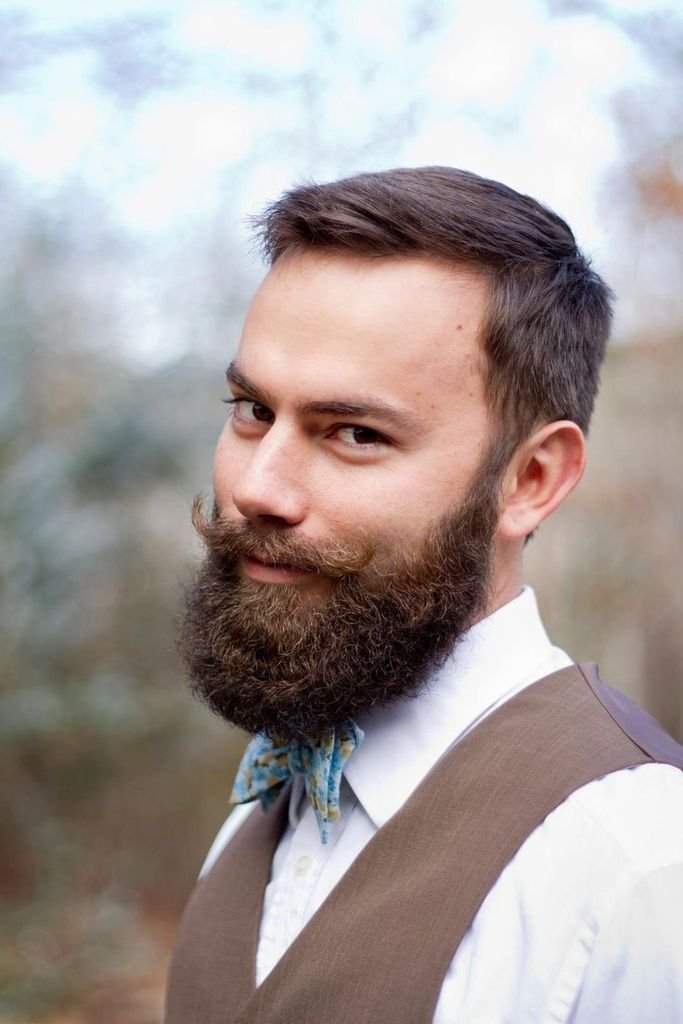
The growth period of a handlebar moustache:
Many people ask me how long it takes to grow a respectable handlebar moustache. When I say, "about three months," I can see crests falling. There are a few points I would like to make about this. Just because your handlebar moustache is not fully mature early on, it doesn't mean it looks bad right up until day 90. In fact, it can look pretty decent all the way through the growing. During the growing period you may end up using a little extra wax to keep untrained hairs out of your mouth. Yes, I said untrained hairs. Unless you have had a handlebar for a while your moustache thinks it is "business as usual" and will grow is its natural pattern. It may surprise you that lip hair has a pattern, but just like the hairs on your beard or your head moustache hair has a preferred growth pattern. This three month growing period does two things. First, it allows the inner hair to catch up to the outer hairs. Second, the time period allows the wax to train the hair to go the direction you want it to grow.
Tricks during the growing period:
These are all optional but may make you feel more comfortable joining the handlebar moustache fraternity. Use what you like and ignore the rest.
Week One and Two:
Grow out a normal 90's goatee or a full beard. This lets you get some length without standing out too much. Prior to week two you really won't have enough hair to even begin waxing the ends. That said, a little moustache wax is handy even if you don't want to grow a handlebar. Some folks even use wax to keep fly-away eyebrows under control. Unless you are a fixture on 60 Minutes, you may want to get those eyebrows in check, too.Week Two through Six:
Now you are probably starting to feel whiskers you are used to trimming sneaking into your mouth or tickling your lips. Please resist the temptation to trim these hairs. You will need these later. During this period of growth you will want to keep your wax in your pocket to keep it near body temperature so you can get a dab and train these pesky hairs swept to the right and the left away from your meal.Week Six and beyond:
By now you should have sufficient hair on your upper lip to make the call to have only the handlebar moustache or keep your beard or goatee as sidecars to your awesome handlebar. There is no right or wrong about this. Some purists insist a handlebar should ride stag on your face, others are more lenient as to what constitutes a "real" handlebar moustache. I say do what you'd like and don't listen to the naysayers.Note:
Don't feel compelled to wash out all of the wax every day. When you shower, obviously you should clean up and keep everything hygienic, but you don't need to or want to scrub out all of the wax. First of all, this is nearly impossible to do because moustache wax is made predominantly of wax and oil and is tough to remove entirely without tough soaps like dish soap. Beyond that, this is not good for your skin, not necessary for hygiene and not conducive to training your hairs. Every night, the wax in your moustache provides free training the whole time you are out cold!The "dont's" of moustache growing:
Like the tricks, above, these are guidelines I am offering to you, man-to-man, not rules. Experiment and let me know if you find a better way!
Trimming:
I advise that you give it two to three weeks before trimming any hairs. If a single hair is driving you nuts--guillotine it, but if you can bear it, let them all grow until you get a good idea of which hairs will play along and which ones need to go. I strongly advise against cutting the hairs directly above the lip (which you are used to cutting if you have a goatee now) because then you end up with a handlebar mullet! You want those hairs to grow out and meet the outer hairs in order to get that full and natural look. After a couple of weeks you will start to notice that some hairs just don't belong. I have a few that grow North of the main part of my moustache that just never blend in well, so I trim them with little, sharp sewing scissors. I also trim a few hairs right beneath my nose for the same reason.
Overnight training:
Now this may be controversial, but I noticed that sometimes not matter how much I fiddle with my handlebar or applied wax, the ends tended to curl out to make bull horns (and these do not look great and photograph even worse) or one handle would get bent the wrong way on my pillow as I slept, so I turned to extreme measures. I used a DIY moustache snood while sleeping for a few nights in a row. I went to the drug store and picked up, for a few bucks, a package of nylon stretchy headbands with the little rubber nubs and wore the bad around my moustache and then around the back of my head where that line is under the bump on the back of your skull. This wasn't too tight for me and is reportedly not amorous in nature, but gives you eight or so hours (while sleeping) of hard core moustache training when needed. I have only done this a couple times.
Dedicated comb:
If you are using wax, you will want a dedicated comb so that you don't get wax in the hair on your head when combing it. (This doesn't apply to me exactly, because I am bald on top and keep the remaining hair short.) You will find this accumulates wax, so run it under hot water and use some good dish soap (I like blue Dawn) and a badger haired brush or old tooth brush to clean up the residue here and there. Pro-tip: Blow brying your combs to melt the wax and then wiping on a paper towel may sound like a good idea but then your comb melts like one of Dali's clocks and that will not help you grow Dali's moustache!
Hairs fall out--no biggie:
Hairs will fall out and though it can feel like a setback when you have been spending so much time and energy to get long curled hairs, know that it is normal. One caveat: if your moustache has a heavier coating of wax on it, don't pull a comb through at room temperature because in this specific scenario you may actually be pulling some "live" hairs clean out of their socket due to friction. I recommend cupping your hands and breathing that deep warm lung air into your moustache before combing or passing a blow dryer on low heat over your moustache a few times to soften the wax before combing. This is especially true of stiffer waxes.
Information
Products
As featured:





News & Updates
Subscribe to our non-annoying (about once a month) newsletter where I will let you know what is new, pass on a coupon here and there and share cool things I've found across the web.
© 2015 CanYouHandlebar Moustache and Beard Co.. Ecommerce Software by Shopify


