- Continue Shopping
- Your Cart is Empty
What is beard oil?
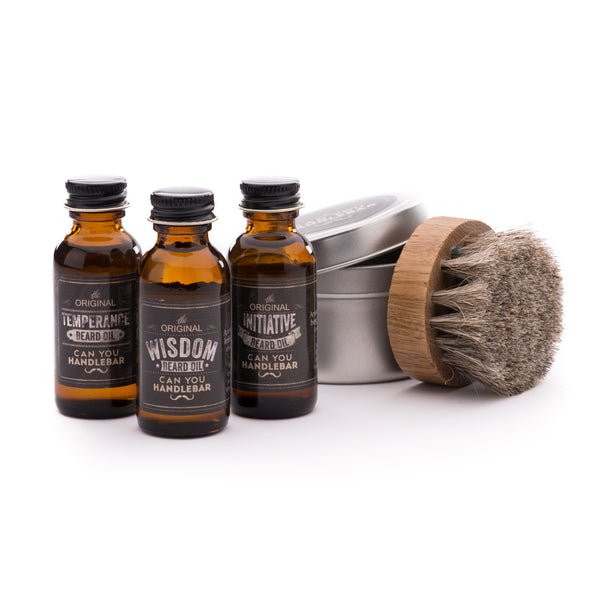
Quick Tip: Beard oil is a conditioning product made of a mixture of base oils for conditioning and essential oils for scent, designed to keep your beard healthy and looking great.
What is beard oil?
You may be new to the world of beard products, you may consider yourself an old pro. But outside of knowing that beard oil can help your beard look and feel better while also keeping it healthier, have you stopped to ask yourself – what is beard oil? As a producer of beard and moustache products, CanYouHandlebar wants to make sure you’re informed about the products you’re using on your beard. You take the time to cultivate your beard, so it makes sense that you would want to take the time to learn a little more about what you put into it.
Beard oil supplements what your body naturally produces
Beard oil is a conditioning product, but if that statement doesn’t tell you enough, think of beard products as a topical supplement designed to give your beard the things it needs to stay healthy and looking great. Daily life or an employment situation that doesn’t expose your beard to the elements can still wear on your beard. Even washing your beard, which is something we recommend of course (with a proper beard soap), can remove some of the oils that keep your beard healthy. So we offer beard oils to help fill in those gaps.
We care about what goes into our beard oils, and you should too
When we first introduced our oils to the CanYouHandlebar community, we wrote: “The base oil was designed to help your beard look great and maintain its health. The aroma is made of high quality essential oils with no cheap fillers. The attention to detail extends to the labeling. Knowing that your beard oil will likely be stored in your bathroom where water and small amounts of oil will get onto the label, we spent a little extra and used water- and oil-proof labels! Your oil will look as good from the day it arrives until you've used the last drop!”
Our beard oils will keep your beard healthy and looking great
With all beard oils, the base oil blend provides the conditioning aspects that keep your beard healthy and help tame it. With a properly produced beard oil, the scent comes only from essential oils, no fragrance oils and certainly nothing that includes alcohol as an ingredient as alcohol can quickly dry out your beard. After applying our beard oil (see more information on How to Apply Beard Oil here), you should notice that your beard looks better and smells great (unless you choose Temperance, our unscented beard oil). While the scent will fade gently throughout the day, the conditioning will not. Our beard oils will keep your beard conditioned as you go throughout your day.
How to fix an uneven moustache
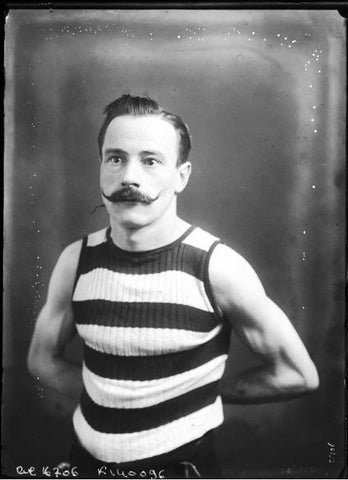
Quick tips: Start with a clean moustache, comb your moustache straight down to check evenness, trim if necessary, or work to adjust your styling technique.
One of the most common questions we receive from fellow growers of facial hair is “My moustache (or handlebar) is uneven how do I fix it?” We are not experts, but we have been around the block a few times, and here are a few tips we have learned that may help you along the way.
Start with a clean moustache, comb it straight down
Especially when considering uneven handlebars, you must make sure that it is your moustache that is uneven and not your styling technique. Start with a clean moustache, fresh out of the shower after a good wash with Every Day Beard Soap, apply the beard oil or beard dry oil of your choice and then use a flat iron (if your moustache is long enough) or hair dryer on a low heat setting, and moustache comb, and comb your moustache straight down. Don’t be afraid to make multiple passes to make sure your moustache is lying as flat as possible.
Check your moustache closely for evenness
Check your moustache closely in the mirror. Does it appear even? It may not look even all the way across, but you want the parts that are directly opposite each other to be the same length, so the outermost tips should be the same length, the innermost parts right above the split of your upper lip should be the same length, and so on. Should you decide that a trim is in order, do so judiciously and with caution, trimming even just millimeters at a time. Place a ruler or even a level flat across your moustache to help you gauge the evenness on the outermost points.
Style your moustache to check your work
Once you have trimmed, if that was necessary, take some time and use some Primary or Secondary wax and style your moustache as you normally would. However, a quick caveat; if you did use a beard oil or dry oil when straightening your moustache, take a moment to wash that out prior to styling. The extra oil can degrade the wax mixture and reduce the styling capabilities of the wax. However, don’t hesitate to utilize the flatiron or hairdryer here, to make sure the wax is evenly distributed through your moustache as an uneven amount could cause uneven handlebars. Check for evenness, repeat the early steps if necessary, or sit back and admire your handiwork.
Tip for entrepreneurs and idea people: how to get out of first gear
Long Version:
I have had a variation on this conversation with a few people recently and so I figured it might be helpful for some of you. Here is the scenario
- You have lots of good ideas
- You tell your friends about your good ideas
- They say "yep, sounds like a good idea"
- You feel a sense of satisfaction that you have a confirmed good idea
- You get stalled and never ship that idea
- You beat yourself because you have a habit of quitting as soon as you have solved it in your head
Deja Vu
Does this sound familiar? Perhaps a year or two later you see "your" idea in the marketplace and you poke your wife, husband or friend in the ribs and say , "remember when I thought of that?!" When I thought about starting CanYouHandlebar I felt like there was a gap in the market for a brand that was:
- Upfront with ingredients. So many brands have proprietary mixes and I wanted to know what was in the wax that would invariably get in my mouth from time to time
- Awesome at customer service. This was never meant to be a get rich quick business. It was meant to be built one relationship at a time and I give my customers the benefit of the doubt more than maybe I should. I tell the truth about when I have screwed up even when I could get away with bending the truth a little
- Designed for people that appreciate a simpler time. If you don;t have any sense of nostalgia then my brand probably doesn't appeal to you. I miss the idea of living in a neighborhood where neighbors knew each other and smoking was healthy. I with we all could meet up every night at Cheers and grab a drink and catch up
- Really high quality. I don;t cut corners I could cut that you'd never know the difference. I make stuff I am proud to wear and I am not the cheapest guy in town because of that. I think making something the right way is worth it for everyone.
So. That was my idea. I mulled it over for a year and filled pads of paper with notes and took lots of screen shots that inspired me. I also stalled. I found ways to put off important next steps and I got discouraged. Then I had the idea that got me out of first gear and eventually launch on November of 2012: I leveraged my own pride. I don't know if I read this from somewhere or made it up myself. I just knew that if I could force myself into a situation where my pride was threatened enough I would follow through. First, I paid for a logo before I even had my recipe down for my first two waxes. That got me going for a couple weeks. When I felt myself stalling again, I bought 10 pounds of lanolin that I sat on my desk as a reminder that I was "all-in" as far as my ego was concerned. What was I going to do with that much lanolin if I didn't follow through? I know that lanolin would haunt me unless I sold enough wax to get rid of it. That did the trick for me.
Short Version:
If you have doubt, laziness or anxiety keeping you from following your dream, put your pride on the line and you'll be amazed how your mind goes from noisy to focused. I hope this Wisdom helps you take Initiative!
How often should I wash my beard or moustache?

Photo: jenny downing
Overview
If you ask four people how often you should wash your beard, you will get five answers. The following is my take, but I trust you'll experiment and find what works for you. But before I offer my $.02, I know guys with amazing beards that swear by weekly shampooing and others that go daily. So, it is not like one or other other is a guaranteed terrible idea. I shampoo every day or two and I always use conditioner. I shampoo more or less often depending how messy of an eater I have been more than anything, (or if I have been around smoking or other things that stick to hair). More important that HOW OFTEN is HOW you condition.
Things to consider as part of your beard hygiene regimen:
Soaps and Shampoos
If you use a soap or shampoo that is not too harsh and you scrub the skin under your beard well, you will clear out the microorganisms that cause a lot of itchiness and flaking. (This is the same reason we scrub our underarms with soap). You know I sell some great beard soap. Try it, if you haven't yet. It does a good job of getting you clean without being too harsh, without pulling hairs our prematurely, and it smells great in the morning. No matter what you will lose a few hairs per day. This is normal.
Use a good beard oil
Use a good beard oil every day or every other. You don't need a ton. Just a nickel sized pool in your hand. Start at the ends and work your way toward your face. Contrary to what you may have heard, the goal isn't to coat your chin skin with oil like putting maple syrup on pancakes. Your skin already produces oils. You are getting the parts of the hair that your sweat doesn't reach. If you have flakes--skin conditions notwithstanding--it is your cleaning regimen NOT a lack of beard oil that is to blame.
What I have learned from the experts
Like I said above, there are LOTS of strong opinions. Mine come from experience and from conversations with barbers, Title Beard and trainers at the Aveda institute so I tend to take them at their word as experts. The good news is, it is relatively inexpensive to experiment and find out what works for you! Be sure to check out the TitleBeard Facebook page again for tons of reviews and tips!
Here are some thoughts from Brian at TitleBeard that are along the same line:
"...I wash my beard everyday. Many beardsman advocate only washing once or twice a week, but I have always said that with proper cleansing and conditioning products, daily washing is fine. But if you don’t like washing your everyday, don’t! Also, on average, I condition my beard in the morning after I get out of the shower, and again before I go to bed, and if I decide to use a beard wax to achieve a particular look that day, I may end up using anywhere from 3-4 different beard products throughout the day. Do you have to do this? Absolutely not, it is simply what works for me."
How to properly apply moustache wax

Quick version of how to apply moustache wax
I spent some time today creating a guide for applying moustache wax.
- Pre-work: warming the wax
- Step One: admire the can
- Step Two: scrape some wax
- Step Three: transfer to finger tips
- Step Four: rub between fingers
- Step Five: confirm wax is melted
- Step Six: wax back of moustache
- Step Seven: wax rest of moustache
- Step Eight: wipe off excess wax
- Step Nine: confirm all is well
Moustache wax application under different scenarios
Touch ups:
In this picture I am just doing a “touch up” so I focused mostly on the ends of my handlebar moustache. In addition to touching up the tips, I occasionally add a little wax to the lip line before dinner to keep those hair out of my mouth and a dab for any fly aways. I basically trace the side of the moustache, starting in the middle and working my way out to the ends. The ends are where most of the wax is needed. The middle of the moustache doesn’t support or look good with a ton of wax because you are breathing out at ~98.6 degrees all day long and constantly melting anything you put there.
Fresh application:
When I have just taken a shower, I start with a totally dry moustache (oil and water don’t mix!) and put a light amount of wax in the center, working my way out and, as above, focus most of my attention on the tips. I like to use a hair dryer on low heat to ensure no wax clumps are visible and to make sure I am not dragging a comb through wax that at holding strength. If you pull a comb through wax that isn’t warmed you may pull out hair ahead of schedule. I recommend combing the freshly waxed hairs down first and then to the right and left. After the hairs are combed I gently twist the ends toward my face, using extra wax as necessary.
Under construction:
If your handlebar moustache is still in the growing phase, use more wax because it is training the hairs to grow the right direction, soothing the skin underneath that my be scratched by hairs as they grow out and it will help you resist the temptation to trim at the hairline and give yourself a mullet handlebar moustache. After three months, start using less wax in the middle (see above).
Emergency touch-up tips:
I live in Michigan and have had to apply or reapply wax under less that optimal conditions. Here are some tips and tricks for these emergency situations. In a vehicle: crank the heat up to high and use it to warm the wax and to blow onto your moustache after application to melt any clumps. I turn all vents “off” except for the one right in front of me to get maximum airflow on my face. Then I cup my hands to aim all of the air at my moustache. This is surprisingly effective.
Armpit:
Your armpit is the closest you can get to your body’s core temperature that isn’t illegal in some states. Putting your wax in your armpit for several minutes will soften it better than riding shotgun in your pants pocket (where I normally carry my Primary6)
Cup your hands:
If all else fails, you can use your own breath to soften the wax you’ve just applied. The trick is to breathe in through your nose and out through your mouth. Cover your mouth like you are sneezing and you will be exhaling nearly 99 degrees of heat to your moustache. After 10-15 breaths you can usually get a pretty decent outcome. Just pay close attention to clumps and use as little wax as possible to reduce the amount of wax as possible–the less you use, the less you have to try to warm with your own breath. The tips you can warm by rolling them back and forth with your thumb and forefinger.
For the full article click here.
Grow a real Handlebar Moustache, not a fake one!
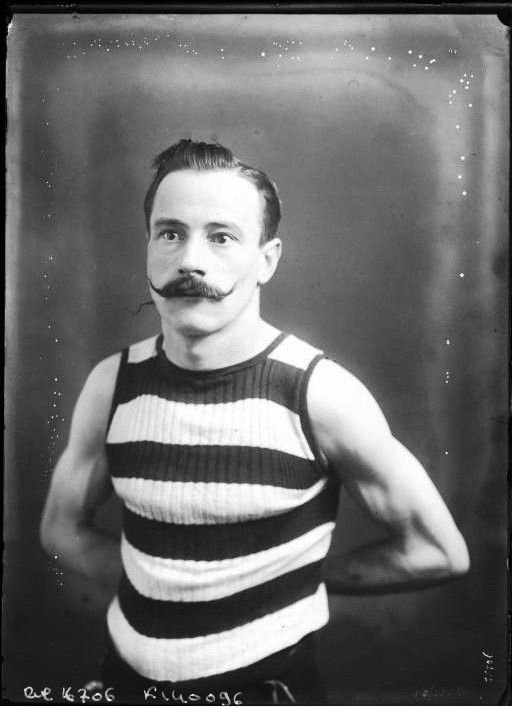
Resist the urge to trim!
If you are like I was, it will go against your usual habits to resist trimming. Because facial hair is cut at a 90 degree angle to the shaft each time you shave, when it starts to grow and make contact with the skin, it will be scratchy. The natural tendency will be to cut off the offending hairs--especially the ones that annoy you by itching your lips or the corners of your mouth.
Here's the thing: you may need these hairs later and should not trim anything until at least two or three months in when you can positively confirm the offending hair is truly useless. You want to have as many hairs as possible to work with once you get you moustache up and running. Trust me on this one.
I repeat: resist the urge to trim!
The worst thing you can do is to trim along the lip line like you do when maintaining a goatee or short cropped moustache. This will give you a mullet-moustache. No good. Think of your hairs as chess pieces--would you purposely sacrifice every one of your pawns for a short-term gain at the beginning of the game? You wouldn't. Those pawns may become powerful players someday. Stay strong!
CanYouHandlebar goes to Rwanda
Using CanYouHandlebar? two degrees below the equator
Last month my wife and I visited our sponsored child Agnes, who is studying to be a journalist in one of the finest schools in Rwanda. The school is run by a Christian philanthropy organization that provides a bright future for the desperately poor, and street boys of Rwanda, a country that suffered a devastating genocide 18 years ago. Many of the kids we met were without family or were the products of rape or prostitution. That is the sad part. The hopeful part is the present unity of the country as Rwandans (no longer Hutus and Tutsis). The trip defies description in many ways, though I have spent many words trying in the weeks since my return. Instead of trying to describe every sight, sound and emotion I thought I would share my goals. I had several while I was in the the country (not in priority order):
Goal 1: Test CanYouHandlebar? moustache wax on safari:
I wanted to know if my waxes would stand up to the heat of the African sun just South of the equator (Preview: they worked really well!)
Goal 2: Meet our sponsored child:
We wanted to do more than send a few bucks a month. We wanted to show Agnes that we truly loved her and were committed to her for the long term. We also wanted to give her a hug. It was great.
Goal 3: Soak up experiences:
Expose myself to things that are truly different than I would ever see in the United States and be as open to whatever I came across as possible.
Goal 4: Test my worldview:
My definition of what it means to be poor has shifted. My belief in the free market as a way to lift individuals out of abject poverty has been buttressed by my visit to a women's training center wherein young women too old for school are taught a skill that will ensure they have food on the table each night.
Goal 5: Fix two sewing machines:
I didn't know this would happen but I had the opportunity to help fix two old sewing machines with my survival bracelet.
Goal 1: Test CanYouHandlebar moustache wax on safari?
As you'll see below, on safari, I was not exactly at my most dapper. During the ten day trip I only shaved a couple times because I had to use bottled water to avoid getting some wacky disease from the local water and I didn't want to waste a bunch of perfectly good water just to get smooth cheeks every morning. Being in Rwanda makes you think a lot about priorities.
The giraffe posed for me. It was so real it felt fake.
On this safari we spent hours in a Toyota van that had little to no air conditioning. We had to roll the windows up for the first hour or so to keep out the horse-flies (they are roughly the size of a small horse) that hang out in the tall grass at the entrance. It was pretty warm, as you might imagine. But the heat and long ride were totally worth it by the time we got to the giraffes, hippos and plain buffalo.
To be entirely honest, I wondered how my wax would hold up. I took this shot on the way home from seven hours of safari. I touched up once or twice during the day (mainly because O wiped the sweat off my face so much I lost some wax in the process) but my handlebars never drooped! I was using Primary6 and the experience made me feel really good about the product. I was two degrees below the equator and Primary6 delivered!
Goal 2: Meet our sponsored child
A few months ago my wife and I started sponsoring a 16 year old girl in Rwanda, named Agnes, who is studying hard in school and wants to one day be a journalist. We heard about a great organization named Africa New Life Ministries and they are completely legitimate. I saw it first-hand. Agnes was very sweet and had poise beyond her years.
Goat are awesome. Did you know they have horns? I like to think they are little handlebars.
She was very appreciative of what we brought and though very quiet, she warmed to us as the days went by. It was really cool to not only have the chance to meet her and give her a goat (that I named "Happy"). We also visited my mother-in-law and sister-in-law's sponsored girls. This is a shot of my wife's mom's girl in her first ride in a van going to her first restaurant. You can't not be thankful for what you have after meeting these great people.
Amerite was so sweet. I couldn't help but wonder what she was thinking. She was so appreciative for the clothes, supplies and monthly support that lets her attend school.
Goal 3: Soak up experiences
Rwanda is the land of juxtaposition. I know it is a huge cliche, but I have never met such genuinely nice people. From the kitchen staff that made our meals at the guest house to the vendors in the market to the villagers that gathered around during the home-visits--we saw so many more smiles than I am accustomed to in the Midwest. The country was torn apart a brief 18 years ago. In 90 days close to a million Rwandans died during a methodical and evil genocide. In the years since, the country has begun the hard work of rebuilding. Literally.
The bricks are soil cut into rectangular brick and left to dry in the sun. The scaffolding is made of local trees lashed together. Definitely not OSHA. :}
We were watching homes under construction in every village and the power grid was small and spotty. The soil was a striking rust color and it made even weeds look awesome because of the contrast. Accordingly, flowers looked like magic growing out of the ground. With so many hills and gorgeous plants--a shack in Rwanda would be a $750,000 view in the States. Cars aren't too common and all of the taxis are little scooters. Here is one I snapped a picture of on our way back from a home visit.
The taxi drivers almost all sold calling cards as a side hustle. Go free market!
Without getting into the politics, suffice to the world could have done a lot more to help during those dark days. We can't go back in time, but we can do something to help now. If you want to learn more about changing the life of a child check out ANLM.
Here is what changed me: I saw the stark contrast between the boys that were not yet sponsored, "street boys" that got two meals a week and the sponsored children who were fed daily, went to school and had health insurance. The difference between their lives is literally $40 per month. I have been skeptical about these faraway charities my whole life. Seeing the difference first-hand changed me. If you have ever wanted to know that you did something good, that made a dent in the universe. If you ever wanted to be absolutely sure of that, sponsor a child. Here is another child we visited and his proud father.
Here is the one of the families we visited. This father and his son were kings for the day because they had a brand new soccer ball (and pump with spare needles). This replaced a ball made out of banana leaves tied together with twine.
It was hard to leave each home after the visit. The hand marks on the back of our van were made by the excited children who were so glad we came and helped a family in their village and brought that village a new soccer ball. It was really and sad and joyful all at once.
Goal 4: Test my worldview
I didn't grow up with a lot of money but I never hated those that did. I always was inspired by people who found a way to use their brain and their creativity to create something other people wanted to buy. Nobody is truly self-made, but I do believe we can all find ways to improve our lives if we work hard and learn from our mistakes. And I still maintain that is true in America. However, in Rwanda I saw people with absolutely nothing. Not a place to sleep, a next meal or even many good examples of how to climb out of the poverty. With strategic giving we can give them the tools to innovate and thrive.
No shame. No fear. Incredible poise and determination to get through the day. It made me feel lazy.
My worldview of free market remains intact, but I now see a place for investing in the truly poor if they are working toward self-sufficiency. That is what I love about ANLM. They are providing education and vocational training not hand-outs or guilt-driven pity money. I heard story after story of kids that graduated and then turned around and sponsored kids, themselves. That is cool.
Goal 5: Fix two sewing machines
I did not expect to actually do something useful while in Rwanda. I mean I know hugging kids that have never been hugged and handing out soccer balls is technically something; but I never expected to do something actually productive. I don't think random white guys from Michigan are probably what Rwanda has on their list of "things we think will help us," but I had a cool opportunity to take apart the paracord bracelet I wore each day to use it as a drive belt for sewing machines at the women's vocational center. I gotta admit, it felt pretty cool.
Here are the rows of machines on which the women learn to sew.
Here is a machine with no drive belt…I see an opportunity…
"I love it when a plan comes together" :}
So I start unraveling. It took about 30 minutes…
This is a picture of me handing two seven foot lengths of 550 paracord to the lady who runs the sewing program. I kept the scraps as a reminder of the day.
Thanks for reading this post. I want you to know more about me and why I do what I do. A portion of the proceeds of CanYouHandlebar? go to this organization and someday I hope to release a collectors edition of my wax in packaging made in this very room.
For more information on sponsoring through ANLM, click here.
Thanks for reading!
Why is CanYouHandlebar wax named Primary and Secondary?
Our trip to Rwanda
Last month my wife and I visited Rwanda to spend time with our sponsored girl Agnes. We sponsor her through an organization called African New Life Ministries (ANLM). As many of you may know, Rwanda is still recovering from a horrific genocide that occurred over three months in 1994. While we were listening to "I saw the Sign" by Ace of Bass or "All I Wanna Do" by Cheryl Crow, a million were listening to radio broadcasts that galvanized a nation into killing their neighbors, spouses and "friends." That is the sad part, and is definitely part of the story, but that isn't the whole story.
The country is rebuilding and it is really incredible to see the hope and ingenuity. A country that used to be mostly either Hutus or Tutsis now has only Rwandans. A country that used to be a battlefield the size of Maryland is now becoming a country committed to getting rid of corruption and rebuilding their society. They could teach us a thing or two about forgiveness and hope.
One of the coolest things we saw was the thirst for education. The picture, above, is a picture of John Bosco, one of Rwanda's top students and attends an ANLM school and served as our translator when we met my wife's sponsored child. In the Rwandan school system, the primary school goes through grade six (Primary) and the next step is a secondary school that also goes through grade six (Secondary). So, Primary is tough, but Secondary is a little tougher. Get it?
Let's get really literal here: each can of CanyouHandlebar? moustache wax supports the great work of Africa New Life Ministries and their commitment to building up the next generation of Rwandans. We hope that that each time you pull out your tin to tame your whiskers you realize you are putting hope into a country and taming poverty and illiteracy. Thanks.
Information
Products
As featured:


News & Updates
Subscribe to our non-annoying (about once a month) newsletter where I will let you know what is new, pass on a coupon here and there and share cool things I've found across the web.